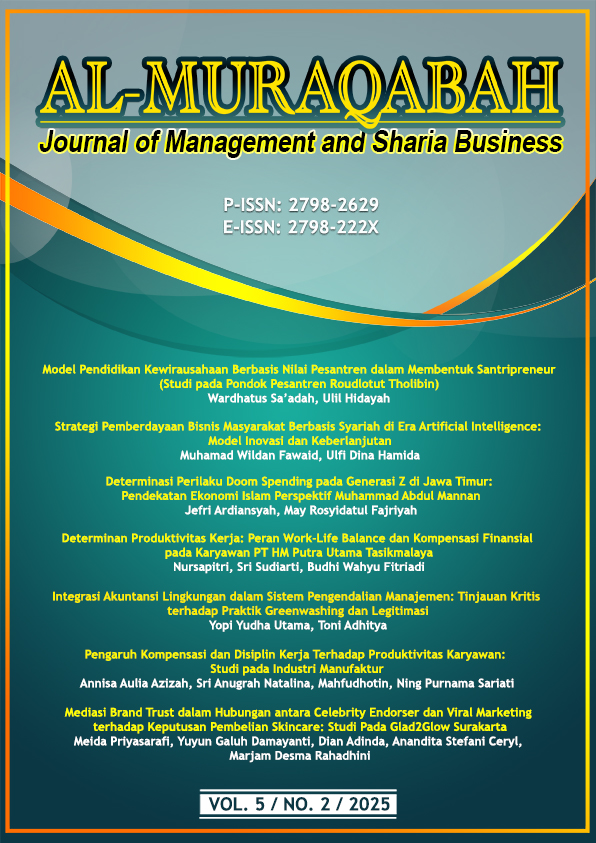
Integrasi Akuntansi Lingkungan dalam Sistem Pengendalian Manajemen: Tinjauan Kritis terhadap Praktik Greenwashing dan Legitimasi
DOI:
https://doi.org/10.30762/al-muraqabah.v5i2.3201Keywords:
Akuntansi Lingkungan; Manajemen Berkelanjutan; Akuntansi Manajemen Lingkungan; Teori LegitimasiAbstract
Tuntutan keberlanjutan mendorong organisasi untuk memposisikan akuntansi lingkungan sebagai bagian integral dari praktik manajemen berkelanjutan, bukan sekadar alat pelaporan. Namun, masih terdapat kesenjangan antara adopsi akuntansi lingkungan dan perubahan substantif dalam pengambilan keputusan manajerial. Penelitian ini menganalisis secara kritis peran akuntansi lingkungan dengan mengintegrasikan perspektif Environmental Management Accounting (EMA), Management Control Systems (MCS), teori legitimasi, dan greenwashing. Metode kualitatif deskriptif melalui studi literatur mengungkap bahwa akuntansi lingkungan memiliki potensi transformasional yang kondisional, tergantung pada integrasinya ke dalam sistem pengendalian dan proses strategis. EMA berperan dalam internalisasi biaya lingkungan, namun berpotensi menjadi simbolik tanpa integrasi MCS. Akuntansi lingkungan juga berfungsi sebagai mekanisme legitimasi yang ambivalen, dapat mendorong akuntabilitas maupun memicu greenwashing. Novelty penelitian terletak pada pendekatan integratif yang memposisikan akuntansi lingkungan sebagai praktik manajerial-institusional yang terikat pada sistem pengendalian dan dinamika legitimasi.
References
Adams, Carol A. “The International Integrated Reporting Council: A Call to Action.” Critical Perspectives on Accounting 27 (March 1, 2015): 23–28. https://doi.org/10.1016/J.CPA.2014.07.001.
Bebbington, Jan, Carlos Larrinaga, and Jose M Moneva. “Corporate Social Reporting and Reputation Risk Management.” Accounting, Auditing & Accountability Journal 21, no. 3 (March 28, 2008): 337–61. https://doi.org/10.1108/09513570810863932.
Boiral, Olivier. “Sustainability Reports as Simulacra? A Counter-Account of A and A+ GRI Reports.” Accounting, Auditing & Accountability Journal 26, no. 7 (September 16, 2013): 1036–71. https://doi.org/10.1108/AAAJ-04-2012-00998.
Braun, Virginia, and Victoria Clarke. “Using Thematic Analysis in Psychology.” Qualitative Research in Psychology 3, no. 2 (2006): 77–101. https://doi.org/10.1191/1478088706QP063OA.
Burritt, R L, and S Schaltegger. “Sustainability Accounting and Reporting: Fad or Trend?” Accounting, Auditing & Accountability Journal, 2010. https://doi.org/10.1108/09513571011080144.
Burritt, Roger L., Tobias Hahn, and S. Tefan Schaltegger. “Towards a Comprehensive Framework for Environmental Management Accounting - Links between Business Actors and Environmental Management Accounting Tools.” Australian Accounting Review 12, no. 27 (July 1, 2002): 39–50. https://doi.org/10.1111/J.1835-2561.2002.TB00202.X.
Burritt, Roger, and Stefan Schaltegger. “Accounting towards Sustainability in Production and Supply Chains.” The British Accounting Review 46, no. 4 (December 1, 2014): 327–43. https://doi.org/10.1016/J.BAR.2014.10.001.
Cho, Charles H., Matias Laine, Robin W. Roberts, and Michelle Rodrigue. “Organized Hypocrisy, Organizational Façades, and Sustainability Reporting.” Accounting, Organizations and Society 40 (January 1, 2015): 78–94. https://doi.org/10.1016/J.AOS.2014.12.003.
Cho, Charles H., Giovanna Michelon, and Dennis M. Patten. “Impression Management in Sustainability Reports: An Empirical Investigation of the Use of Graphs.” Accounting and the Public Interest 12, no. 1 (December 2012): 16–37. https://doi.org/10.2308/APIN-10249.
Cho, Charles H., and Dennis M. Patten. “The Role of Environmental Disclosures as Tools of Legitimacy: A Research Note.” Accounting, Organizations and Society 32, no. 7–8 (October 1, 2007): 639–47. https://doi.org/10.1016/J.AOS.2006.09.009.
Contrafatto, Massimo. “Stewardship Theory: Approaches and Perspectives.” Advances in Public Interest Accounting 17 (December 3, 2014): 177–96. https://doi.org/10.1108/S1041-706020140000017007.
Creswell, John W., and Cheryl N. Poth. Qualitative Inquiry and Research Design: Choosing Among Five Approaches. 4th ed. Thousand Oaks: SAGE Publications Inc, 2018. https://books.google.co.id/books?id=gX1ZDwAAQBAJ&printsec=frontcover&hl=id&source=gbs_ge_summary_r&cad=0#v=onepage&q&f=false.
Deegan, Craig. FINANCIAL ACCOUNTING THEORY. 4th ed. Australia: McGraw-Hill Education (Australia) Pty Ltd, 2014. www.copyright.com.au.
Deegan, Craig Michael. “Legitimacy TheoryDespite Its Enduring Popularity and Contribution, Time Is Right for a Necessary Makeover.” Accounting, Auditing & Accountability Journal 32, no. 8 (November 19, 2019): 2307–29. https://doi.org/10.1108/AAAJ-08-2018-3638.
Epstein, Marc J., John Elkington, and Herman B. “Dutch” Leonard. Making Sustainability Work : Best Practices in Managing and Measuring Corporate Social, Environmental and Economic Impacts. 1st ed. London: Routledge, 2018. https://doi.org/10.4324/9781351280129.
Figge, Frank, Tobias Hahn, Stefan Schaltegger, and Marcus Wagner. “The Sustainability Balanced Scorecard - Linking Sustainability Management to Business Strategy.” Business Strategy and the Environment 11, no. 5 (September 1, 2002): 269–84. https://doi.org/10.1002/BSE.339.
Gond, Jean Pascal, Suzana Grubnic, Christian Herzig, and Jeremy Moon. “Configuring Management Control Systems: Theorizing the Integration of Strategy and Sustainability.” Management Accounting Research 23, no. 3 (September 1, 2012): 205–23. https://doi.org/10.1016/J.MAR.2012.06.003.
Gray, R H, Carol A Adams, and David L Owen. Accountability, Social Responsibility, and Sustainability: Accounting for Society and the Environment. Pearson Education Limited, 2014. https://api.semanticscholar.org/CorpusID:153818439.
Gray, Rob. “Is Accounting for Sustainability Actually Accounting for Sustainability…and How Would We Know? An Exploration of Narratives of Organisations and the Planet.” Accounting, Organizations and Society 35, no. 1 (January 1, 2010): 47–62. https://doi.org/10.1016/J.AOS.2009.04.006.
Henri, Jean François, and Marc Journeault. “Eco-Control: The Influence of Management Control Systems on Environmental and Economic Performance.” Accounting, Organizations and Society 35, no. 1 (January 1, 2010): 63–80. https://doi.org/10.1016/J.AOS.2009.02.001.
Jasch, Christine. “How to Perform an Environmental Management Cost Assessment in One Day.” Journal of Cleaner Production 14, no. 14 (January 1, 2006): 1194–1213. https://doi.org/10.1016/J.JCLEPRO.2005.08.005.
Journeault, Marc. “The Integrated Scorecard in Support of Corporate Sustainability Strategies.” Journal of Environmental Management 182 (November 1, 2016): 214–29. https://doi.org/10.1016/J.JENVMAN.2016.07.074.
Kaplan, Robert S. The Strategy-Focused Organization : How Balanced Scorecard Companies Thrive in the New Business Environment. Edited by D P (David P.) Norton and David P Norton. Boston: Harvard Business School Press, 2001.
Larrinaga-Gonzalez, Carlos, and Jan Bebbington. “Accounting Change or Institutional Appropriation?—A Case Study of the Implementation of Environmental Accounting.” Critical Perspectives on Accounting 12, no. 3 (June 1, 2001): 269–92. https://doi.org/10.1006/CPAC.2000.0433.
Maas, Karen, Stefan Schaltegger, and Nathalie Crutzen. “Integrating Corporate Sustainability Assessment, Management Accounting, Control, and Reporting.” Journal of Cleaner Production 136 (November 10, 2016): 237–48. https://doi.org/10.1016/J.JCLEPRO.2016.05.008.
Parker, Lee D. “Twenty-One Years of Social and Environmental Accountability Research: A Coming of Age.” Accounting Forum 35, no. 1 (March 2011): 1–10. https://doi.org/10.1016/J.ACCFOR.2010.11.001.
Porter, Michael E., and Claas Van Der Linde. “Toward a New Conception of the Environment-Competitiveness Relationship.” Journal of Economic Perspectives 9, no. 4 (January 1, 1995): 97–118. https://doi.org/10.1257/JEP.9.4.97.
Schaltegger, Stefan, Delphine Gibassier, and Dimitar Zvezdov. “Is Environmental Management Accounting a Discipline? A Bibliometric Literature Review.” Meditari Accountancy Research 21, no. 1 (July 12, 2013): 4–31. https://doi.org/10.1108/MEDAR-12-2012-0039.
Schaltegger, Stefan, and Marcus Wagner. “Sustainable Entrepreneurship and Sustainability Innovation: Categories and Interactions.” Business Strategy and the Environment 20, no. 4 (May 1, 2011): 222–37. https://doi.org/10.1002/BSE.682.
Simons, R. Levers of Control: How Managers Use Innovative Control Systems to Drive Strategic Renewal. Harvard Business School Press, 1995. https://books.google.co.id/books?id=QLgfmAEACAAJ.
Suchman, Mark C. “Managing Legitimacy: Strategic and Institutional Approaches.” The Academy of Management Review 20, no. 3 (July 1995): 571. https://doi.org/10.2307/258788.
Downloads
Published
How to Cite
Issue
Section
License
Copyright (c) 2025 Yopi Yudha Utama, Toni Adhitya, Isyrohil Muyassaroh

This work is licensed under a Creative Commons Attribution-NonCommercial 4.0 International License.