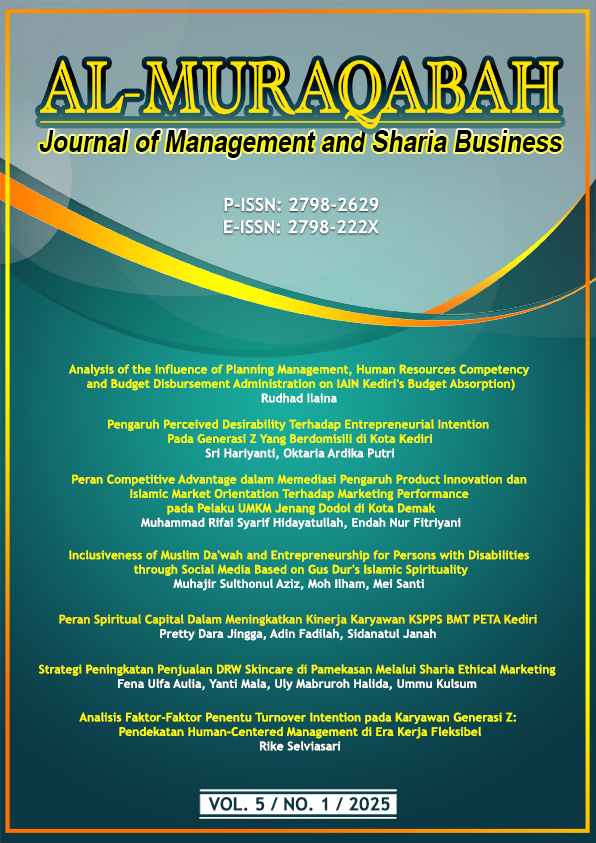
Inclusiveness of Muslim Da'wah and Entrepreneurship for Persons with Disabilities through Social Media Based on Gus Dur's Islamic Spirituality
DOI:
https://doi.org/10.30762/al-muraqabah.v5i1.2297Keywords:
Digital Preaching, Muslim Entrepreneurship, Disability, Inclusivity, Gus DurAbstract
This study aims to explore the transformation of Islamic preaching and Muslim entrepreneurship practices conducted by persons with disabilities through social media, grounded in Islamic spiritual values inspired by the thoughts of KH. Abdurrahman Wahid (Gus Dur). Using a qualitative case study approach, this research focuses on three social media accounts owned by disabled Muslim entrepreneurs: @rumahaspirasitunanetra, @thisablebeautycare, and @ekosugeng. The findings reveal that social media not only serves as a communication tool but also functions as a digital preaching space and spiritual marketplace, reinforcing the role of people with disabilities as active agents of change. The participants successfully integrated Islamic values such as amanah (trustworthiness), rahmah (compassion), and maslahah (public good) into their entrepreneurial and preaching activities. These findings highlight the urgency of inclusive preaching approaches and the necessity to expand the Islamic Value-Based Entrepreneurship (IVBE) model to encompass marginalized experiences. The study concludes that spirituality-based preaching and business can be powerful strategies for social emancipation and for shaping an inclusive Islamic discourse.
References
Anwar, Vebby, Sofyan Hamid, dan Andi Harmoko Arifin. “Entrepreneurship in through Islam Perspective.” Dalam 3rd International Conference on Accounting, Management and Economics 2018 (ICAME 2018), 146–55. Atlantis Press, 2019. https://www.atlantis-press.com/proceedings/icame-18/125917120.
Arısoy Gedik, Cansu, dan Ahmet İlkay Ceyhan. “The gender gap in the digital era: reaching algorithmic fairness and technological inclusivity in network society,” 2024.
Ayob, A. H., dan A. A. Saiyed. “Islam, institutions and entrepreneurship: evidence from Muslim populations across nations.” International Journal of Islamic and Middle Eastern Finance and Management 13, no. 4 (2020): 635–53.
Aziz, Muhajir Sulthonul, dan Moh Ilham. “Muslim Entrepreneurs with Disabilities in Digital Era: A Study of Islamic Management Practices and Social Empowerment.” PAMDI: Indonesian Journal of Islamic Management and Organization 1, no. 01 (2025): 27–37.
Azoulay, Pierre, Benjamin F. Jones, J. Daniel Kim, dan Javier Miranda. Immigration and entrepreneurship in the United States, 4 American Economic Review: Insights 71–88 (American Economic Association 2014 Broadway, Suite 305, Nashville, TN 37203 2022).
Azzman, Tengku Siti Aisha Tengku Mohd, dan Anisa Rasyida. “Examining Factors that Influence IIUM Students’ Involvement in Da’wah Activities via Social Media.” IIUM Journal of Human Sciences 3, no. 2 (2021): 27–42.
Basid, Abdul, Moh Fauzan, Amrulloh Amrulloh, Mujianto Solichin, Ahmad Munjin Nasih, dan Bakri Mohamed Bkheet Ahmed. The Role of Nahdlatul Ulama’(NU) Diplomacy in Promoting Islam Rahmatan Lil ‘Alamin Exegesis to Strengthen Indonesian State-Religion Concepts: A Study of Gus Dur’s Thought, 14 Journal of Islamic Thought and Civilization 224–45 (2024).
Billah, Muktashim, Abdul Qadir Gassing, Muammar Bakry, Kurniati Kurniati, Abdul Wahid Haddade, Darussalam Syamsuddin, La Ode Ismail Ahmad, dan Ahmad Harakan. Islamic law perspectives and social experiences on stigma toward disabled people in Indonesia, 10 Frontiers in Sociology 1479243 (Frontiers Media SA 2025).
———. Islamic law perspectives and social experiences on stigma toward disabled people in Indonesia, 10 Frontiers in Sociology 1479243 (Frontiers Media SA 2025).
Braswell, Harold. Take pity: What disability rights can learn from religious charity, 47 The Journal of Medicine and Philosophy: A Forum for Bioethics and Philosophy of Medicine 638–52 (Oxford University Press US 2022).
Breeksema, Joost J., Alistair R. Niemeijer, Erwin Krediet, Eric Vermetten, dan Robert A. Schoevers. “Psychedelic Treatments for Psychiatric Disorders: A Systematic Review and Thematic Synthesis of Patient Experiences in Qualitative Studies.” CNS Drugs 34, no. 9 (September 2020): 925–46. https://doi.org/10.1007/s40263-020-00748-y.
Choudhary, Eisha. “Aligning Identity, Faith, and Entrepreneurship: Experiences of Muslim Women Entrepreneurs in India.” Journal of Business Anthropology 12, no. 2 (2023): 138–58.
Diana, Carnelia Marta, dan Oktaviana Purnamasari. “Check for updates Public Relations Campaign “From Door-to-Door Mandatory Mask" as Implementation of Aice Group’s Humanitarian Mission.” Dalam Proceedings of the 1st International Conference on Research in Communication and Media (ICORCOM 2021), 729:102. Springer Nature, 2023.
Efendi, M.R., dan H. Kurniawan. “The Influence of Internet Addiction and Sales Promotion on Impulse Buying in TikTok Shop E-Commerce with Religiosity as a Moderation Variable.” Journal of Islamic Entrepreneurship and Management 3, no. 2 (2023): 105–13.
Fathonih, Ah, Grisna Anggadwita, dan Sadudin Ibraimi. “Sharia venture capital as financing alternative of Muslim entrepreneurs: Opportunities, challenges and future research directions.” Journal of Enterprising Communities: People and Places in the Global Economy 13, no. 3 (2019): 333–52.
Floren, Jessen, Tareq Rasul, dan Azmat Gani. Islamic marketing and consumer behaviour: a systematic literature review, 11 Journal of Islamic Marketing 1557–78 (Emerald Publishing Limited 2020).
Gassing, A. Q. dan others. “Islamic law perspectives and social experiences on stigma toward disabled people in Makassar.” Frontiers in Sociology 10 (2025).
Glas, T., dan P. Remeeus. “Politics of Multiculturalism in an Age of Intolerance: Identity Construction and Political Engagement of Religious Students in Yogyakarta, Indonesia,” 2019. https://studenttheses.uu.nl/handle/20.500.12932/33391.
Hoque, Mohammad Azizul, Tasnuva Ahmad, Samira Manzur, dan Tasnia Khandaker Prova. “Community-Based Research in Fragile Contexts: Reflections From Rohingya Refugee Camps in Cox’s Bazar, Bangladesh.” Journal on Migration and Human Security 11, no. 1 (Maret 2023): 89–98. https://doi.org/10.1177/23315024231160153.
Jima’ain, Muhammad Talhah Ajmain. “Dawah in the Digital Age: Utilizing Social Media for the Spread of Islamic Teachings.” Journal of Current Social and Political Issues 1, no. 1 (2023): 1–7.
Khalique, Muhammad, T. Ramayah, Khushbakht Hina, dan Jamal Abdul Nassir Shaari. “Islamic entrepreneurship: a systematic review of future challenges and prospects of Pakistani SMEs.” International Journal of Economics, Management and Accounting 28, no. 2 (2020): 277–95.
Kholili, M., Ahmad Izudin, dan Muhammad Lutfi Hakim. “Islamic Proselytizing in Digital Religion in Indonesia: The Challenges of Broadcasting Regulation.” Cogent Social Sciences 10, no. 1 (31 Desember 2024): 2357460. https://doi.org/10.1080/23311886.2024.2357460.
Ko, Kwonmok, Gemma Knight, James J. Rucker, dan Anthony J. Cleare. Psychedelics, mystical experience, and therapeutic efficacy: A systematic review, 13 Frontiers in psychiatry 917199 (Frontiers Media SA 2022).
Mehmood, Muhammad Umar, dan Zahida Parveen. “Exploring the Islamic Perspective on Special Persons: A Study of the Quran and Hadith.” AL-ĪMĀN Research Journal 2, no. 03 (2024): 114–28.
Melvia, Dwi Arta, dan Mohammad Ilham. “ANALISIS MANAJEMEN DAKWAH: KEPEMIMPINAN GUS DUR TERHADAP GENERASI Z.” Dakwatun: Jurnal Manajemen Dakwah 2, no. 2 (2023): 214–24.
Morehouse, Jordan, dan Adam J. Saffer. “Promoting the Faith: Examining Megachurches’ Audience-Centric Advertising Strategies on Social Media.” Journal of Advertising 50, no. 4 (8 Agustus 2021): 408–22. https://doi.org/10.1080/00913367.2021.1939202.
Nanthambwe, Patrick, dan Vhumani Magezi. “Leave no one behind”: Towards a religion and disability-inclusive development in Africa, 81 HTS Theological Studies 1–12 (AOSIS Publishing 2025).
Nasrudin, Nasrudin, dan Sudiro Sudiro. “Gusdurian Islamic Social Movement: Political Discourse, Resource Mobilization, and Framing.” International Journal of Social Science and Religion (IJSSR), 2022, 251–76.
Nora, Elfia, Ery Tri Djatmika, dan Heri Pratikto. “Workplace Spirituality and Its Influence on Innovative Work Behaviour in Micro, Small, and Medium Size Enterprises (MSMEs): The Role of Islamic Spiritual Values in the Contemporary Workplace.” Manchester Journal of Transnational Islamic Law & Practice 20, no. 4 (2024).
Nurlatifah, Hanny, Asep Saefuddin, Marthin Nanere, dan Vanessa Ratten. “Muslimpreneur: Entrepreneur Potential Characteristics in Indonesia as the Country with the Largest Muslim Population in the World.” Dalam Entrepreneurial Innovation, disunting oleh Vanessa Ratten, 129–39. Studies on Entrepreneurship, Structural Change and Industrial Dynamics. Singapore: Springer Nature Singapore, 2022. https://doi.org/10.1007/978-981-16-4795-6_12.
O’Sullivan, Michael. Interest, usury, and the transition from “Muslim” to “Islamic” Banks, 1908–1958, 52 International Journal of Middle East Studies 261–87 (Cambridge University Press 2020).
Randeree, Kasim. Demography, demand and devotion: driving the Islamic economy, 11 Journal of Islamic Marketing 301–19 (Emerald Publishing Limited 2020).
Renard, John. Seven doors to Islam: Spirituality and the religious life of Muslims. Univ of California Press, 2023.
Rofiuddin, Mohammad, dan Muhajir Sulthonul Aziz. “AL RAZ MUSLIM FASHION PRODUCTION MANAGEMENT STRATEGY IN FACING BUSINESS CHALLENGES DURING THE COVID 19 PANDEMIC ISLAMIC ECONOMIC PERSPECTIVE.” Wasilatuna: Jurnal Komunikasi dan Penyiaran Islam 5, no. 1 (2022): 1–14.
Sahid, Mualimin Mochammad, Ahmad Nur Jihadi, dan Setiyawan Gunardi. “Moderate Islam as a solution to pluralism in the Islamic world: The experience of Indonesia.” Al-Shajarah: Journal of the International Institute of Islamic Thought and Civilisation (ISTAC), 2019, 1–24.
Said, Muhammad. “Virtual Preaching Activism In Indonesia: Social Media, Politic of Piety, New Ulama, and Democracy.” Jurnal Penelitian 17, no. 1 (2020): 1–14.
Said, Nurhidayat Muhammad, Novi Yanti, dan Siti Nuri Nurhaidah. “The Existence of Women’s Da’wah in the Dominance and Marginalization of Patriarchal Culture.” Journal of Ecohumanism 3, no. 4 (2024): 953–65.
Saleh, Sadhriany Pertiwi, Hafied Cangara, Safiyyah Sabreen, dan Syamsuddin Ab. “Digital da’wah transformation: Cultural and methodological change of Islamic communication in the current digital age.” International Journal of Multidisciplinary Research and Analysis 5, no. 08 (2022): 2022–43.
Taiba, Saira, Razia Shabana, dan Zainab Moin. “Pluralism, Tolerance, and Islamic Philosophy: Implications for Global Peace and Conflict Resolution.” Harf-o-Sukhan 7, no. 2 (2023): 1–11.
Wahid, Abdurrahman. Islamku, Islam Anda, Islam Kita: Agama Masyarakat Negara Demokrasi. Jakarta: The Wahid Institute, 2006.
Downloads
Published
How to Cite
Issue
Section
License
Copyright (c) 2025 Moh Ilham, Muhajir Sulthonul Aziz, Mei Santi

This work is licensed under a Creative Commons Attribution-NonCommercial 4.0 International License.